

Ibn Sina and the Builder Who Walks Away

We talk about artificial intelligence as though it were something you build and then own. A finished object. You train the model, you ship it, and now you have it, the way you have a bridge once the last bolt is torqued. This is the quiet assumption underneath almost everything said about the field of AI, and I have come to think it is the deepest error we are making. Not an error about how far the technology can go. An error about what kind of thing intelligence is in the first place, which is the more fundamental question, and the one few are asking.
A thousand years ago someone was asking a version of it. Ibn Sina, the Persian polymath the Latin West would come to call Avicenna, was born near Bukhara around 980 and spent a life moving between courts as a physician, an astronomer, a vizier, and above all a philosopher of being. He wrote a medical encyclopedia, the Canon, that was translated into Latin and taught as the standard text in the universities of Montpellier, Bologna, and Paris for the better part of five centuries, well into the sixteen hundreds. His philosophical summa, the Book of Healing, ran so deep into the nature of existence that it shaped European scholasticism directly, Aquinas included. Ibn Sina is one of the few genuinely foundational minds in the history of the subject, and near the center of his metaphysics sits a distinction that cuts straight to the mistake we are making now.
He noticed there are two completely different ways a cause can relate to its effect. Some causes bring a thing into being and then leave. A builder raises a house, and when the builder dies the house still stands. He was the cause of the house coming to be, but he was never the cause of the house continuing to be. The house does not need him anymore. He was, in Ibn Sina’s terms, an accidental cause, one that runs ahead of its effect in time and then drops away.
There is a second kind of cause, and it does not get to leave. Its effect exists only for as long as the cause is actively holding it in existence, at every moment, without pause. The instant the cause stops, the effect does not fade or decay or wind down. It simply is not there anymore. Ibn Sina called this the cause that bestows existence, and he argued it has to be simultaneous with its effect, present at the same instant, continuously, or the effect collapses into nothing.
Think of light. Not the bulb, the light itself. The bulb is an object that sits on a shelf, but the light is not an object at all. It exists only in the act of being produced. Cut the current and it is gone in the same instant, not slowly, not partially, gone. Light is a sustained thing. It is happening, or it is not.
Here is why an eleventh century distinction suddenly matters. A large language model is built exactly like a house. There is a period of construction, which we call training, enormous and expensive, and then the construction ends. The weights freeze. The builder walks away. What is left is a finished structure that persists on its own, unchanging, the same tomorrow as today, a magnificent house standing in a field long after anyone stopped working on it. The training was a cause of its coming to be. Nothing is a cause of its continuing to be, because it does not need one. That is what it means for the weights to be frozen. The thing is done.
You will hear that this is no longer true, that the newest systems learn as they go. Look closely and the house is still a house. A longer context window is a bigger room, not a live current, and whatever the model takes in during a conversation is held for the length of that conversation and then swept out when it ends, so the model on the far side of the reset is precisely the one that walked into it. Retrieval bolts a library onto the house and lets the model read from it, but reading is not being changed. Fine-tuning does change the weights, and it changes them the way a renovation changes a house, in a discrete campaign of construction that begins, ends, and freezes again, after which the builder walks away one more time. None of it is the thing a mind does, which is to be continuously altered by the world in the present tense, without pause, as a condition of existing at all. The impression of a living, updating system is the projection. The frozen structure is the fact.
In Ibn Sina’s terms, a mind is not a house. A mind is light.
And this is not only a metaphor. It is close to a literal description of what a mind physically is, and the science that says so is some of the deepest we have. There is a family of things in nature that exist the way light exists, only in the act of being sustained. A flame. A whirlpool in a river. A living cell. The physical chemist Ilya Prigogine won a Nobel Prize for the study of them and gave them their name, dissipative structures, patterns that hold their shape only by continuously taking in energy and matter and passing disorder back out, standing against the universe’s constant pull toward evenness and decay. Stop the flow and the pattern does not persist in a weakened form. It vanishes, because it was never a thing, it was always a process wearing the appearance of a thing. A whirlpool is the clearest case. It has an edge and a shape and a location, it can spin in one spot for hours, you can point straight at it, and yet it is not a thing at all. It is only water being pulled through a particular pattern, and the water passing through it is never the same water twice. Dam the river upstream and the whirlpool is not damaged. It is simply gone, because it was never anything but the river moving. Erwin Schrödinger, the physicist whose wave equation helped found quantum mechanics, spent his later years on a different question, what separates the living from the dead, and set his answer down in a small and famous 1944 book called What Is Life? An organism, he wrote, stays ordered only by continuously drawing order from its surroundings, and the moment it cannot, it slides into the flat equilibrium we call death. A mind is the most intricate dissipative structure we know of. It is a flame made of prediction.
Karl Friston, a neuroscientist at University College London and one of the most cited scientists alive, gave this its exact modern form in what he named the free energy principle, and it is the engine underneath everything I have been arguing across these pieces. A system that maintains any boundary between itself and the world, that stays a distinct thing rather than dissolving into its surroundings, can only do so by continuously minimizing the gap between what it predicts and what the world actually delivers. It has to keep guessing the world and keep being corrected, moment to moment, or the boundary fails and the thing stops being a thing. Existence, for a mind, is not a state you arrive at and hold. It is an act you perform without stopping. Grounding, then, is not a foundation you pour once during construction and then build on top of. It is the current. It has to be live, or it is nothing.
No intelligence in nature was ever built once and then left running. While there are hardwired instincts, fixed behaviors an animal is born already knowing, those instincts do not run on frozen parts. They run on living tissue that is active every instant the animal is alive, continuously firing, continuously modulated by the world around it, never left decoupled from reality the way a trained model is, because a nervous system on pause is the end of that intelligence, an extreme surprise, in Friston’s terms, from which there is no return.

Now picture two drones sent through the same stretch of forest. The first was trained exhaustively beforehand and flies on a policy fixed at the factory, a beautiful house of a system, and for a while it is astonishing, right up until it meets a branch at an angle that was not in the world it was built from, and then it has nothing, because the builder already walked away and left no one home to adapt. The second is not finished, because it was never meant to be. It is in the loop, seeing and correcting and seeing again in the present tense, and when the branch comes at the wrong angle it does what everything alive does, it adjusts to a world that did not consult its training, and it threads through. One of those is running on a fire that is still lit. The other is a photograph of flight.
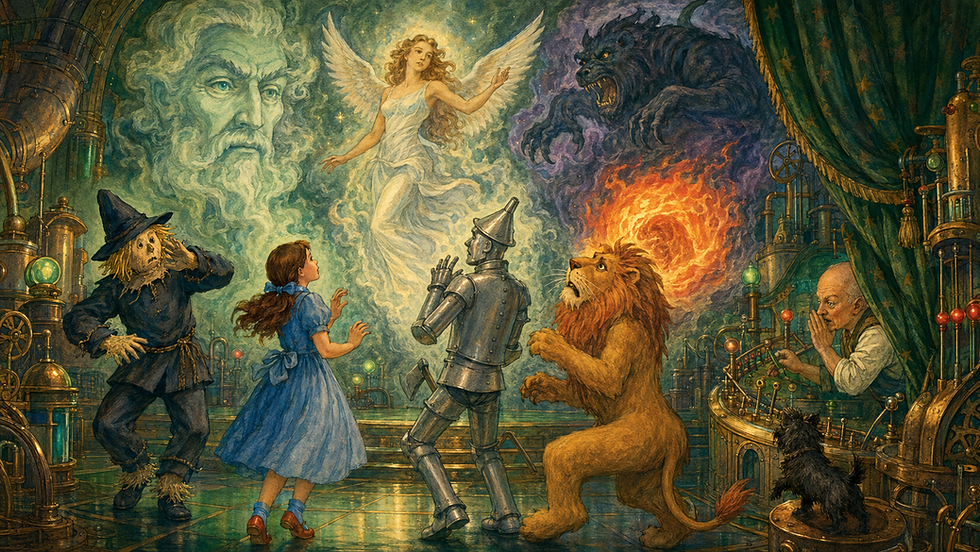
In the story of Oz, the wizard’s power turns out to be an apparatus, a machine he built once to throw an enormous, overwhelming face onto the wall and then simply ran, projecting the same image on a loop, the same today as yesterday, asking nothing of him but that he keep working the controls he had already installed. A dazzling projection, finished, self-contained, with no contact to the world outside the room it performed in. That is the thing we are building, and getting better and better at building. The travelers standing in front of it were the opposite kind of thing entirely, alive to the road, changed by every step of it, corrected the whole way by a world that pushed back. One of those is a mind. The other is a very good machine for working the levers.
Later in his life Ibn Sina ran a second thought experiment, one that has never stopped being debated. Imagine a person created fully formed in a single instant, suspended in empty air, in total darkness, touching nothing, feeling not even the weight of their own body, with no memory and no sensation of any kind. Like a human clone formed and awakened within a sensory deprivation tank. His claim is that this person, with every input to the mind stripped away, would still affirm one thing without hesitation: that they exist. That there is someone there. From this he argued that the self is not the body and is not assembled out of the senses, because it can be known when the body and the senses are gone. Six hundred years later the French philosopher René Descartes would arrive at nearly the same place through a different door, stripping away every belief he could bring himself to doubt until only the doubter was left, and give it the phrase everyone remembers, I think therefore I am.
Now hold his two arguments side by side, because the same mind made both and they seem to pull in opposite directions. One says a mind exists only in continuous contact with the world and vanishes the instant that contact is cut. The other says the self remains even when all contact is cut. That looks like a contradiction. It is actually the most important distinction, and it is the whole architecture of what we are building.
The two arguments were never about the same thing. The sustaining cause, the light that is not a house, is about intelligence. The working mind. The thing that perceives and acts and reasons and threads a drone through a forest. That is a live process, a flame, and it cannot survive one instant cut off from the world, because contact is the very thing holding it in existence. The Flying Man is about something else entirely. It is about the witness. The bare fact that there is someone there at all, that it is like something to be you, the awareness that would remain in the dark after every input was stripped away.
And notice what kind of thing that witness is, because Ibn Sina put his finger on its strangest property. You can never make it an object. You cannot turn around fast enough to catch the one doing the looking, cannot get behind the seeing to see the seer. It is unknowable, not in the sense that it is hidden or mysterious, but in the exact sense that the knower can never be the known. You do not observe it. You are it. It is the one thing in the universe you have by being it rather than by looking at it. Call it the unknowable silent witness. Silent because it never speaks, and unknowable because it can only ever be the subject of knowing, never the object.

There is a witness, which can only ever be a subject. There is a world, a real physical territory, which can only ever be an object, and which the witness can never touch directly, because a bare awareness cannot grip a world, and a bare awareness pressed against raw reality is not a life. So between the two sits intelligence, and intelligence is a space suit. It is the only thing that lets the witness reach a world it could not survive touching with its bare hand. Perception, prediction, the body, the loop that acts and is corrected, all of it is the suit. And the suit is exactly the thing Ibn Sina described a thousand years ago. It is light, not a house. A living process that has to stay in contact or it is nothing. The witness rides inside of it. The world pushes back on the outside of it. The suit is what couples the one to the other, and grounding is simply the suit being worn and used to explore this reality.
This is why intelligence and consciousness were never one thing. A rover on Mars, driven by our best minds, grips a world no human could survive touching bare-handed. It is a suit with intelligence inside it and no one home. The witness, the inner light the Flying Man points to, is unknowable by nature. Building the suit does not require answering it. That is the part nature has already solved, in millions of forms, and the part we can build. I believe we can build intelligence past our own, but only as an interface, never as a consciousness in itself.
So then the way forward is a different kind of thing, an intelligence that is never finished because it was never meant to be, one that exists the way everything alive does, by staying in contact with the world and being corrected and punished by it, moment after moment, in the present tense, and without the expectation of consciousness. We call it Enactive AI, eAI, intelligence grounded in acting on and perceiving the world rather than in predicting the next word about it. That is what we are building at Absentia Technologies. Not a house. Not a projection thrown on a wall. A way to broaden our experience of reality and our own abilities to experience this world.
Read more about what we are building at Absentia Tech → absentiatech.com
Emanouil Angelov is Co-Founder of Absentia Technologies and a screenwriter who has been writing films about artificial intelligence since 2017. His background spans professional filmmaking, cinematography, photography, marketing and teaching. His work at Absentia is informed by the intersection of visual perception, linguistic theory, and AI architecture.
Comments