

The Emerald City Was Never Green, and Neither Is the State of AI
When I was seven my mother took me to a bookstore so I could buy a book for the first time with my own money. I had been saving in a piggy bank for a while, and I walked out with L. Frank Baum’s The Wizard of Oz. It was a rewarding read even for a seven year old. Everything felt like it had a deeper reason for being the way it was. It felt crafted and deliberate. So you can imagine my shock when our heroes finally reached the Wizard, the one entity who could answer every question.
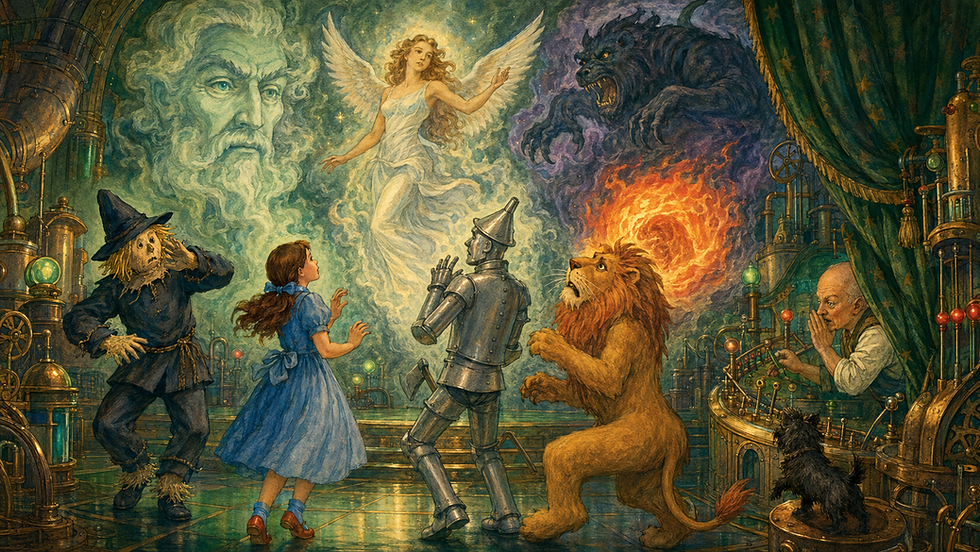
In Baum’s novel the travelers reach the Wizard one at a time, and he is never the same thing twice. Dorothy meets an enormous floating Head. The Scarecrow meets a beautiful winged woman. The Tin Woodman meets a terrible Beast. The Cowardly Lion meets a Ball of Fire. Each of them trembles before the form best suited to overwhelm them. Then Toto, who is not afraid because he does not understand enough to be afraid, knocks over a screen in the corner of the room, and behind it stands a small bald man in his shirtsleeves, working a set of levers and speaking through his hands. “I have been making believe,” he tells them. “I am just a common man.” He has a word for what he is. Humbug.
The Wizard shows each visitor a different face, and this is not Baum being whimsical. We are pattern-completing animals. We see intention where there is only incident, and a mind where there is only mechanism, and the same instinct is now turning a statistical text engine into Pandora’s box. Like the travelers in the throne room, we each see the form best suited to overwhelm us. The optimist sees the winged woman, intelligence about to lift the species. The doomer sees the Beast. The investor sees the great Head that will answer any question if you kneel in front of it long enough. Same machinery in the corner. Different projection on the screen.
Before anyone is allowed into the Emerald City, the Guardian of the Gates locks a pair of green spectacles onto their face, even onto Toto, and keeps the key on a chain. The city is not green. It is ordinary stone and ordinary glass. It looks like a fortune in emeralds because everyone is required to view it through green lenses, and because no one is permitted to take them off. I think that’s a great allegory for the present market. The capital, the demos, the leaderboard scores, the launch events, the breathless coverage, the valuations with no floor under them. These are the spectacles. They are issued at the gate. You cannot raise a round, book a meeting, or publish a take without putting them on first. And green, as it happens, is the color of money. The city glitters because we agreed to wear the lens that makes it glitter, and almost everyone standing inside it holds equity in keeping the glasses locked.
When the humbug is exposed, he still has to deliver, so he gives each traveler what they came for. He opens the Scarecrow’s head and packs it with bran stuck full of pins and needles and calls them bran-new brains. He gives the Tin Woodman a heart of silk stuffed with sawdust. He pours the Lion a green liquid and tells him it is courage. None of it is real. All of it works, because the recipients believe it does. This is benchmark culture exactly. We open the model’s head, pour in another trillion tokens, post a higher number on a test we wrote ourselves, and announce that reasoning has arrived. The capability that gets advertised is the bran and the pins. It is a symbol of the thing. But a map is not the territory, in Alfred Korzybski’s famous phrase, and I do not think a high score is a mind.
Notice what the Wizard actually is. A voice and a face with nothing behind them. He drifted into Oz in a balloon, by accident, and stayed because the people decided he was magic. He has no contact with the world outside his throne room and cannot step out of it without being found out. This is the part the metaphor gets exactly right. A system trained on the residue of human language has read every account of fire and never once been near the heat. Give it a camera and you have not given it contact, only more residue, because a photograph is a description too. It has touched nothing it describes.
So when it does not know, it does not stop. It does what the Wizard does. It projects the most convincing image it can and speaks with total authority through its hands. We call this hallucination, as if it were a defect, a bug to be patched in the next release. It is not a defect. It is the whole nature of the machine, and to see why you have to look at the one thing that does this well, which is the brain, and find the single part it has that the model does not.
Here is what a century of neuroscience keeps finding, and it is stranger than the marketing. The brain is not a camera that takes in the world. It is a guessing engine running a controlled hallucination, predicting the world and checking the prediction against what arrives. Helmholtz saw it in the nineteenth century and called perception an unconscious inference. The modern name is predictive processing, and the claim is blunt. Your brain is always generating its best guess of what is out there and correcting only the error, the gap between what it expected and what it got. You can watch this happen in the simplest way there is. You cannot tickle yourself, and the reason is that your brain predicts the exact sensation your own moving hand is about to produce and quietly cancels it before it lands, keeping only what it did not see coming. Rig up a machine that adds a half second delay between your movement and the touch, so the prediction no longer matches, and suddenly you can tickle yourself after all. The brain is never feeling the world directly. It is feeling the difference between the world and its own guess. Your experience of reading this sentence is a controlled hallucination, a guess your cortex is making and fixing in real time. And Dorothy’s Oz was a controlled hallucination too, the way every world is. The difference is that Oz could fight back. She had to adapt to every surprise it threw at her, and being corrected by it, step after step, was the only thing that ever got her home.
So prediction is not the flaw. Prediction is the method. A language model and a human cortex are doing something unnervingly alike, each producing the most probable next piece of a pattern. The brain’s guess is dragged back and corrected by a body that acts on the world and pays for being wrong. Reach for the pan, feel the burn, never reach the same way again. The error comes from outside, from a world that pushes back and does not care what you predicted. The model’s guess is corrected by nothing but more text. Its loop is closed. There is no outside, no floor, no burn. It picks the most probable next word, it does not consult a world to check the last one, and nothing inside it knows the difference. A guessing engine with no world to answer to will guess straight into the void, fluently, forever.
Computer science has a precise name for this and no cure for it. Stevan Harnad called it the symbol grounding problem in 1990. How could a symbol ever mean anything to a system that only ever trades it for other symbols, none of which it can cash out for the thing itself? More than three decades and a thousandfold more compute later, not one symbol has been grounded. When a problem will not dissolve no matter how much scale you throw at it, you are not short on compute. You are digging in the wrong field.
When Dorothy turns on the little man, he does not deny what he is, but he says something true. “I am a very bad Wizard, I must admit, but I am a very good man.” The models are good men. They are genuinely useful, and most of the people building them are serious and honest about the limits once you get them off the stage. The humbug is not the technology. The humbug is the performance we agreed to stage around it, the floating Head we keep building in front of an ordinary man at a control panel, because a control panel does not move the valuation. You know what does move it: Skynet, HAL 9000, Ava, the list is long. It is exciting because it is dangerous. But let us leave science fiction to the storytellers.
There is one more scene worth remembering. When the Wizard finally tries to leave, he does it the only way he knows, by filling a balloon with hot air. The ropes slip before Dorothy can climb aboard, and he rises up over the city and floats away, waving, leaving everyone precisely where he found them. That is how this kind of thing tends to end. Not with a crash but with a slow ascent on hot air, the showman carried off by the same medium that lifted him, and the crowd left standing in a city that was never made of emeralds.
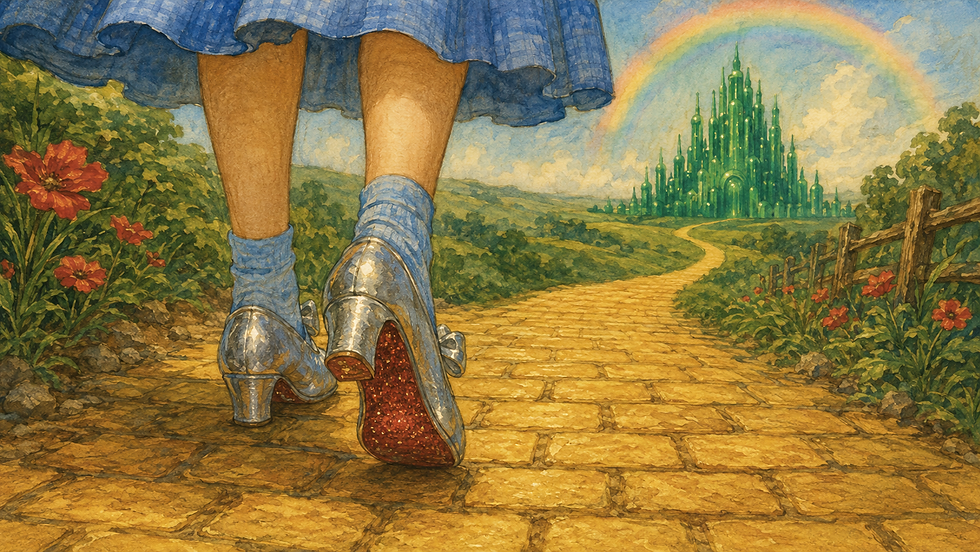
Which brings me to the shoes. Dorothy crossed a continent and risked her life to beg the great and powerful Oz for the power to get home, which she had on her own feet the entire time. The silver shoes were the grounding she always needed to get home. Three clicks and she was back in Kansas.
And here is what I missed as a seven year old, reading with the green glasses I did not know I had on. The Wizard was the only fake in the book. Everyone else was the real thing. The Scarecrow spends the whole road out-thinking every obstacle in the party’s way, which is the one thing a creature with no brain is not supposed to do. The Tin Woodman is the one who feels everything, who weeps when he steps on a beetle and rusts his own jaw shut. The Lion walks straight at every danger between the cornfield and the Emerald City. They earned their minds and hearts and nerve the only way anyone ever has, by moving through a world that could hurt them and being changed by what it did. They too were grounded. The Wizard, who never left his room, who touched nothing, who only ever projected and spoke, was the one running on hot air. In a way Baum wrote the plot of today’s AI craze. The travelers are what intelligence actually looks like. The man behind the curtain is what we are building on hype.
So the way home was never in the throne room, and it was never a larger Head. It has been sitting in plain view in a different field the entire time. Not in computer science, which built the throne room and keeps adding rooms to it, but in biology, which has spent a century studying the only intelligences that have ever existed. They have one thing in common. Not one of them learned the world by reading about it. They scaled it by moving through it.
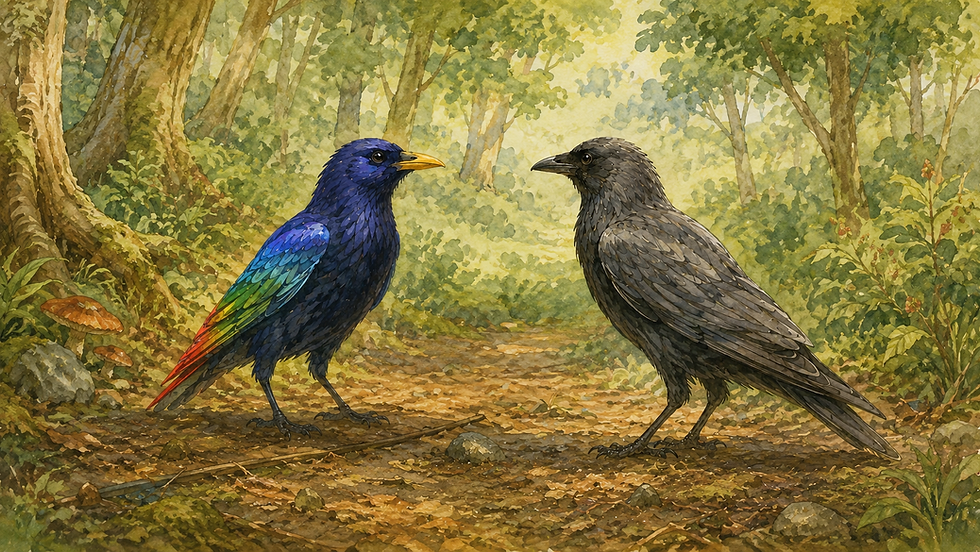
Jakob von Uexküll named this a hundred years ago. Every creature lives inside its own Umwelt, the slice of the world its body and senses can act on, and nothing past that slice exists for it at all. A tick’s entire world is three signals. A crow sees colors we have no words for, because it carries a fourth kind of cone in its eye, so its world holds distinctions ours cannot. There is no view from nowhere, no neutral world waiting to be downloaded whole. Perception is not a recording. It is an act, performed by a particular body, that brings a particular world into being.
The psychologists Kevin O’Regan and Alva Noë argued you do not see by receiving a picture at all. You see by knowing, in your body, how the scene would shift if you moved, and you keep almost none of it stored inside you, because the world is sitting right there to be checked again the instant you need it. Francisco Varela gave the whole idea its name, enaction, mind not as a mirror held up to a finished world but as something that brings a world forth by acting in it. Karl Friston gave us the Free Energy Principle, the machinery of perception and action folded into a single loop, the organism moving through the world in order to close the gap between what it predicts and what it meets in order to avoid surprise, which equals death. The prediction only works because there is a body to correct it. Take the body away and you are left with the Wizard and hot air.
The thing the AI field is chasing in the throne room cannot be found there, because it was never made of language to begin with. It is made of contact. The silver shoes represent a body to interface with reality. Intelligence was never going to be downloaded from a corpus of text, however vast, for the same reason Dorothy was never going to find home by asking the Head. The power was always in the feet. In grounding to reality.
Neural networks got us here, and that matters. But the road forward is Enactive AI (eAI), intelligence that learns the way everything intelligent has ever learned, by acting in the world and being corrected by it rather than by predicting the next word about it. That is what we are building and researching at Absentia Technologies. We believe the architecture of intelligence was worked out long ago, by evolution, in the only laboratory that has ever produced a mind, nature.
Emanouil Angelov is Co-Founder of Absentia Technologies and a screenwriter who has been writing films about artificial intelligence since 2017. His background spans professional filmmaking, cinematography, photography, marketing and teaching. His work at Absentia is informed by the intersection of visual perception, linguistic theory, and AI architecture.


Comments